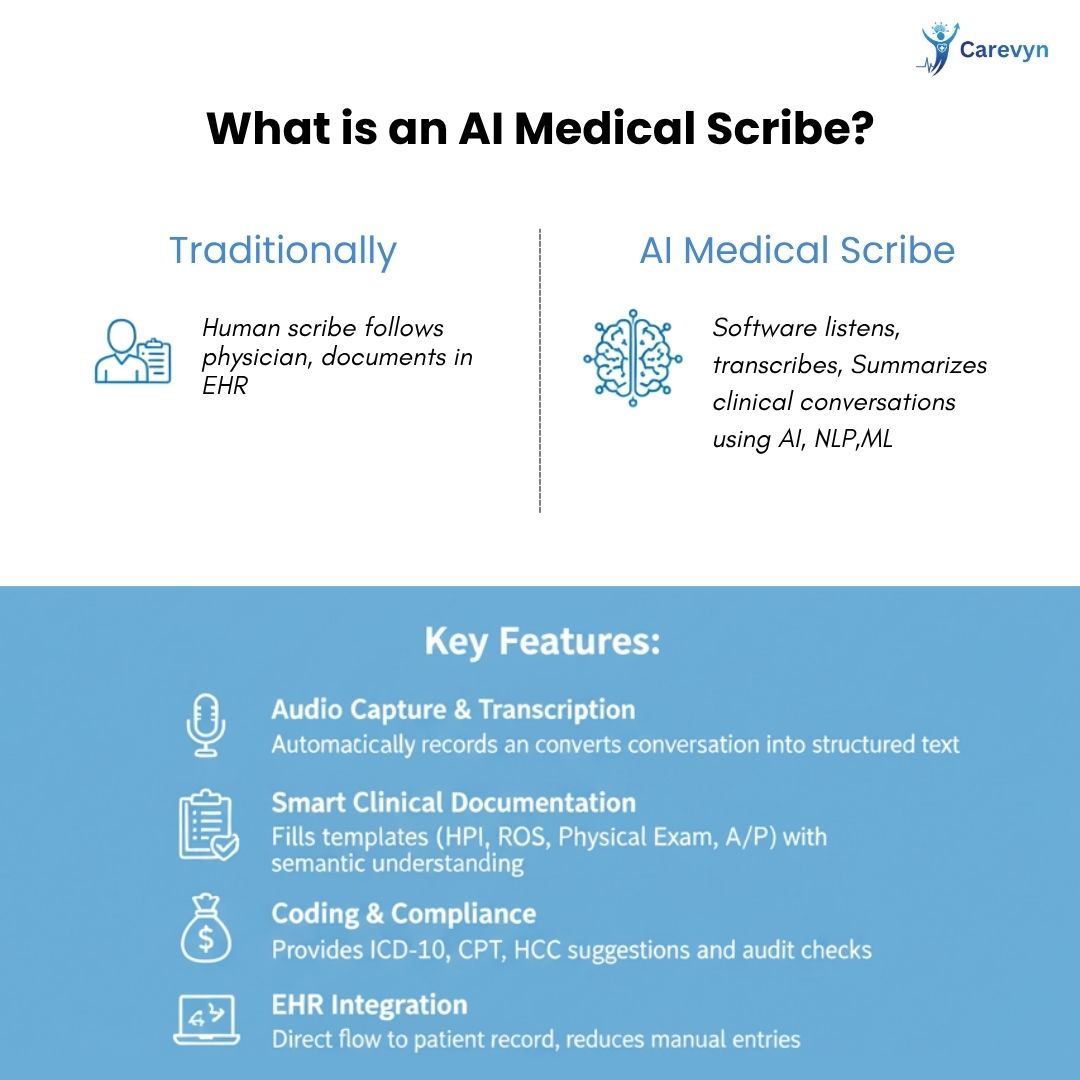
What is an AI Medical Scribe?
Traditionally, ‘medical scribe’ describes a human that follows the physician to the patient's encounter and documents the information in the EHR on behalf of the physician.
Nevertheless, an AI medical scribe represents a new frontier: software that utilizes artificial intelligence (AI), natural language processing (NLP) and machine learning to listen, transcribe, summarize and structure clinical conversations, in real-time or near real-time.
Key features:
-
Automatically capture the audio from the patient– provider conversation and turn it into structured text.
-
Use clinical templates and semantic understanding of clinical language to populate relevant sections -- The History of Present Illness (HPI), Review of Systems (ROS), Physical Exam, Assessment/Plan.
-
Provide coding suggestions: ICD-10, CPT, HCC and embed compliance/audit checks.
-
Integrate with the EHR so that documentation flows directly to the patient record and reduce duplication and manual entries.
In short, the AI medical scribe is a tool that assists providers to save time through eliminating manual documentation and practices to save money through better billing efficiency and less errors or denials.
Why Now? The Case for Saving Time & Money with an AI Medical Scribe
1. The Time Drain on Physicians
Clinical time is finite. However, providers regularly report late-night exhaustion after clinics, as there is simply not enough time in our day, to enter notes, clean up the charts, coding, and other clerical work.
2. Financial Strain on Practices and Health Systems
Inefficiencies in documentation, inaccuracies in coding, claim rejections and administrative redundancies, contribute to an overall elevated cost and decreased revenue.
An AI medical scribe saves costs to practices by:
-
Less time spent on clerical staff or human scribes.
-
Higher revenue through increased throughput (more patients seen or more efficient sessions).
-
Coding efficiency and less claim denials.
-
Better ability to capture revenue and improved speed of claims submission
3. Improving the Physician-Patient Relationship
In addition to cost and time, relieving the physician of excessive typing or data entry opens up more eye contact, more attention on the patient and less interference from the keyboard. Studies have shown that physicians claim they felt like they were able to focus better on their patients, which had a positive impact on their interactions with the patient.
When a patient senses that the doctor is not multi-tasking or preoccupied, patients often feel more trust for the doctor and greater satisfaction with their care, and that is an indirect support of the business case as well.
Carevyn: How it Works
Now, let’s take a look at Carevyn as a platform and how it helps to save time & money for doctors and practices specifically, through the AI medical scribe and coding capabilities.
Overview:
According to the provider’s website, Carevyn’s “AI Medical Scribe & Coding” solution includes:
-
Real-time transcription of patient encounters.
-
Automatic coding: ICD-10, CPT, HCC and structured clinical documentation.
-
Integration with leading EHR systems (Epic, Cerner, Athena, and others).
-
Quality control, minimization of denials and better revenue cycle management.
Three-Step Workflow:
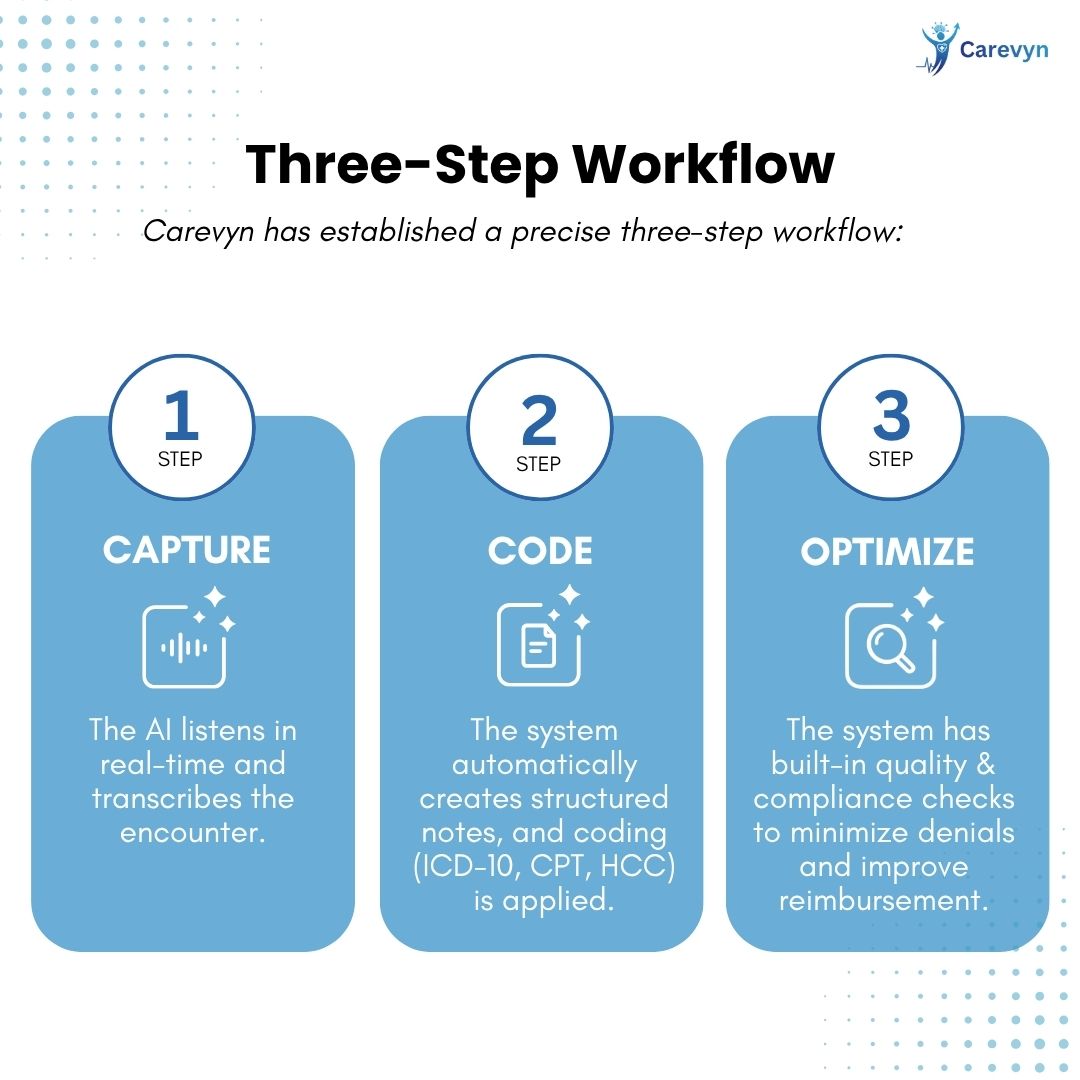
Carevyn has established a precise three-step workflow:
Step 1 – Capture: The AI listens in real-time and transcribes the encounter.
Step 2 – Code: The system automatically creates structured notes, and coding (ICD-10, CPT, HCC) is applied.
Step 3 – Optimize: The system has built-in quality & compliance checks to minimize denials and improve reimbursement.
Tangible Metrics of Impact
The following shows some reported outcomes (which can be useful in describing the time and money impact):
-
Up to 3 hours saved daily per provider on documentation.
-
More than 30% decrease in claim denials in the first 6 months.
-
$500K+ annually recovered in opportunity cost for a mid-size provider group.
-
98%+ coding accuracy.
Why This Matters?
-
Save Time: If a physician saves even 1–3 hours a day on documentation, that will depend on patient care, seeing more patients, or decreasing burnout and after-hours work.
-
Save Money: By converting time into less denials, accurate coding, quicker submission of claims, and less staff time all save costs and maximize potential revenue.
Carevyn Helps Physicians Save Time & Money: Five Factors
Let’s explore five particular ways that Carevyn (in its capacity as an AI medical scribe platform) saves time and money for providers.
1. Eliminating Manual Note-Taking
Manual charting is slow and often inaccurate. Carevyn, automates capturing conversation, which means that your provider no longer has to write, or type, extensive notes during or after their visit. Just that is a significant time savings. Integration into the EHR means fewer duplicate entries.
2. Improving Coding & Billing Accuracy
Coding (ICD-10, CPT, HCC), which is complicated, and mistakes will cost money regardless of the method (under billing, audits or denials). Carevyn suggests codes automatically, with embedded compliance checks, which thereby reduces mistakes, facilitates billing, and reduces denials. That is bottom line cost savings and increased revenue.
3. Claims Submission is Faster & You Reduce Denials
One metric cited: claims submission is 2.5x faster than the manual workflow. It also lowers denial rates (~30% lower), which means less time spent with communication, appeals, and staff/user time spent chasing claims. That is both time (for follow-up) and money (administrative costs) savings.
4. Allows for More Patient Time
All these points contribute to better satisfaction and potentially increase retention of patients, that potentially support better care outcomes, which can also indirectly support the financial sustainability of a practice.
5. Ability to Scale and Flexibility for Various Specialties
Carevyn is designed to be engaging across solo practices, small clinics, hospitals and specialty practices (e.g. cardiology, orthopedics, and behavioural health).
As your practice grows, Carevyn allows you to scale, which equates to lower incremental cost, and specialty workflows developed by the AI create less need for workarounds, and fewer (if any) manual corrections, thus saving time and money.
Examples and Evidence
Even though we can't provide you with a (publicly available) peer-reviewed randomized control trial that examines Carevyn, we can report evidence and parallels from studies and data on AI medical scribes in general, in addition to the metrics reported by the vendor.
-
In a major rollout by The Permanente Medical Group, Ambient AI medical scribes saved (mostly all) physicians 1 hour of screen time every day.
-
Evidence of improvements in documentation time, provider burnout, and physician to patient interaction have been reviewed in published literature on AI medical scribe adoption although they also cover ethical/legal/operational issues as well.
-
Carevyn claims: 90% provider satisfaction with reduced burnout; over $500K annual revenue was recovered in mid-sized groups; over 98% coding accuracy; and a 30% reduction in claim denials.
These data points demonstrate the ways a medical scribe, like Carevyn, is helping deliver both time savings and cost-savings to practices and health systems.
Considerations for Implementation: Successfully Deploying an AI Medical Scribe
Adopting an AI medical scribe is not as easy as flipping a switch.
1. Select the Right Solution
-
Make sure that the AI medical scribe works with your EHR (integration does matter) and your workflow.
-
It also is helpful to confirm accuracy, specialty-specific capabilities, code support, and comply with regulations (HIPAA, SOC 2).
-
Also consider scalability and cost model. The initial cost may not be trivial, however make sure the return on investment in time and money makes sense.
2. Train and Onboard Providers
-
Physicians and staff must be trained to review and approve the notes completed by the AI. Agreement & oversight are important at this time: no AI scribes are automatic without reviewing by the physician. American Medical Association
-
Now, to improve user adoption, they need to trust the system, and the early wins matter.
3. Ensure Data Privacy & Security
-
AI medical scribes are being placed on status of communication between patient and clinician; ensure that it gets patient consent and has secure data use.
-
If the EHR is integrated, make certain that encryption and audit logs are part of and included in the integration also with HIPAA and regulations.
4. Track Performance Metrics
-
Track time saved per provider, claim denial rate, revenue capture, staff/admin workload, physician satisfaction.
-
Set up benchmarks for monitoring (1–3 hours saved per day, 20–30% fewer denials) review regularly.
5. Manage Change in Workflow
-
Clinical documentation workflow models will change; staff positions will evolve!
-
Make sure that the physician stays at the center (AI is a tool and definitely not a replacement), and make sure to monitor quality. Certain literature speaks to the potential risks of the "hallucinations" of AI.
In light of increasing healthcare expenses, limited physician availability, and rising administrative responsibilities, the thought of an AI medical scribe is intriguing. Solutions like Carevyn promise to create the necessary change, enabling providers to save time documenting, and saving costs via more efficient coding, less denials, and increasing revenue capture.
For physicians being able to spend more time with patients instead of behind a computer means providing better care, reducing burnout, and job satisfaction. For practices or health systems, less administrative workload, more accurate billing codes, and faster payment improve its bottom line - the finances matter after all.
If your organization is looking to recover clinician time, billing and coding efficiencies, and ultimately save time and money, an investment in an AI medical scribe like Carevyn is worth considering.
Are you ready to experience the future of clinical documentation?
See how Carevyn’s AI Medical Scribe can save your team hours of work every day, reduce costs and allow providers to focus the most important part of healthcare, patient care.
Learn more about Carevyn’s AI Scribe.
Frequently Asked Questions:
Q: Will the AI medical scribe replace the physician?
A: No. The AI medical scribe is a tool that supports the physician. The physician still reviews the note, makes final clinical decisions, and is ultimately responsible for the accuracy of the documentation.
Q: What is the accuracy of the AI medical scribe?
A: AI scribes are not perfect, although the accuracy is increasing, Carevyn claims 98% + coding accuracy. “Hallucinations” as they are referred to in ambient AI scribe systems are documented.
Q: What about cost—how long until ROI?
A: ROI is highly contextual and dependent on practice size, volume, specialty and current levels of inefficiency. However, indicators like “3 hours saved per provider per day” or “30% fewer denials” can be pretty compelling ROI metrics for practice cost reduction.
Q: What about consent and patient privacy?
A: Since patient-clinician conversations are being captured, consent (explicit and/or implied) and secure handling of data is very important. Best practice suggestions are informing patients, having posters/signage, adhering to HIPAA or equivalent regional guidelines, etc.
Q: Are there specialties that it works better or worse for?
A: Yes, the more complex the documentation, the more language variability, and the more people in the conversation the greater need for tuning. That said many AI scribes (Carevyn included) state they can assist specialty practices—many already do and can scale.