The Metrics of RCM: Who Should Be Concerned About Them?
Although RCM will affect various departments, the following leaders will gain the greatest benefit from the systematic performance of metrics:
-
CFOs and Finance Leaders: Responsible for financial performance and accountability, budgeting, forecasting, and operational accountability.
-
Leaders in Revenue Cycle and Directors of Billing: As the front-line owners of throughput, claims process, denial management, and workflow optimization, they acquire greater insight into these areas of RCM than at any other level.
-
Executives Operating the Department: Executives will be responsible for the employee staffing levels, selection of technologies, and performance across departments.
-
Compliance and Risk Management Groups: Their responsibility includes the verification of billing integrity, the compliance of billing with regulations, and as well as their ability to prepare for audit demands.
-
Administrators and Clinical Directors: Front-end accuracy (Registration, Documentation, Coding) will drive the downstream financial performance of RCM.
Tracking RCM Metrics creates greater alignment between the clinical and financial functions, providing better alignment between frontline execution and the organization's financial strategy.
What is RCM Metric and Why Does it Matter?
An RCM metric is a quantifiable measurement that describes the effectiveness and efficiency of RCM processes. RCM metrics provide much more than just numerical quantities. RCM metrics tell a story about how well your financial engine is performing.
Common Metrics Used to Track RCM Performance
Many categories will allow you to drill into the performance of the Revenue Cycle through analytics, with the following being included in your performance categories:
-
Patient Access Metrics
-
Claims and Billing Metrics
-
Accounts Receivable Metrics
-
Denial and Resolution Metrics
-
Financial Performance Metrics
Carevyn allows for enhanced tracking and insight across these categories of metrics through the consolidation of Automated Documentation, Automated Coding, Claims Intelligence, and Predictive Analytics into a single integrated platform.
Monitoring RCM metrics provides financial leaders with numerous insights into their RCM processes such as:
-
They can discover the bottlenecks that cause delays in payment.
-
They are able to identify errors and issues before they can lead to denials (e.g., errors in data entry).
-
They can optimize the workloads and productivity of their staff.
-
They can significantly improve cash conversion time and reduce their cost of collecting cash.
-
They are able to use RCM Metrics to support the development of Strategic Plans for their organizations and/or develop a Financial Forecasting model.
When should you Monitor RCM Metrics
The RCM Metrics are more valuable when they are monitored on an ongoing basis:
-
Daily - For front line operations such as volume of Claims submitted; number of Clean Claims; Registration Accuracy.
-
Weekly - For trends in Denials; Coding Errors; Staff Productivity Dashboards.
-
Monthly - For Financial Scorecards, A/R Performance, Cash Collections, Cost Ratios.
-
Quarterly/Annual - For Benchmarking against Internal Goals, Industry Standards and Strategic Initiatives.
Regular reminders to track these Metrics allow for earlier detection of issues and timelier action to correct them so that cash flow is preserved and there is reduced leakage from revenues.
 (1).png)
Optimize your revenue cycle with consistent tracking of RCM metrics from daily audits to annual benchmarking.
Where RCM Metrics Are Used Across the Revenue Cycle
The Multiple Departmental/Functional Areas of RCM Metrics have a large influence on how well you conduct your business in the Revenue Cycle.
-
Registration/Eligibility: Ensures that data entered at the start of the Revenue Cycle will not result in errors later in the cycle.
-
Clinical Documentation & Coding: Ensures that accurate Clinical Documentation = Accurate Coding = Accurate Reimbursement. Carevyn is powered by Artificial Intelligence Documentation to provide you with the highest level of Accuracy to minimize Re-do and Denial.
-
Claim Submission & Billing: Tracking the amount of Clean Claims submitted and the Average Monthly Time between the initial submission and final payment to the provider indicates the efficiency of your Billing Operations.
-
Denial Management: There are 5 types of Denials in Denial Management (1)Denial of Claims; (2)Partial Denial of, (3)Administrative Denials, (4)Coding Denials and (5)Clinical Denials.
How to Track and Leverage Key RCM Metrics
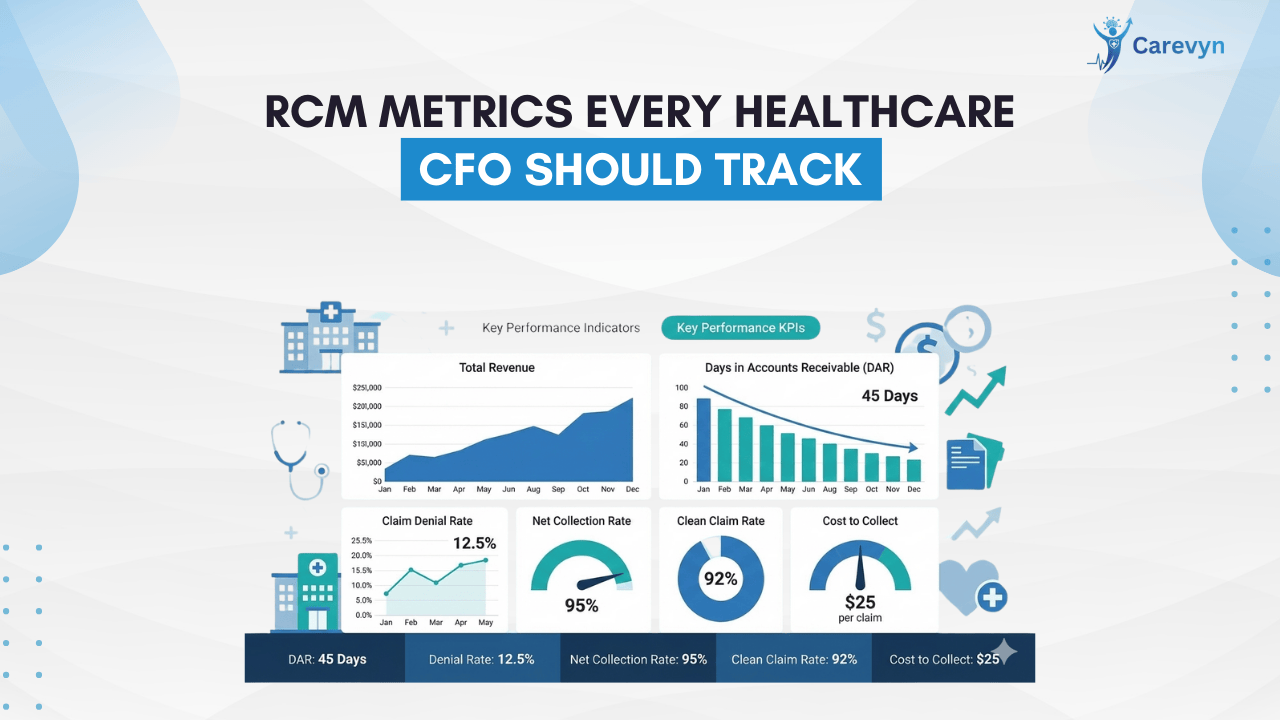
There are several things that you as a CFO should pay attention to in order to successfully manage the financial health of your organisation. The KPI's below will help you to effectively communicate the overall performance of your organisation, to track where your organisation is at currently and where it can be improved:
1) Clean Claim Rate (CCR)
The CCR is defined as the percentage of submitted claims that were accepted without any edits made by a claims processor or payer. When a claim is submitted clean, it helps the reimbursement process become faster and also lowers the risk of claims being denied. The CCR above the average target (90-95% or higher) reduces the amount of wasted time and costs incurred due to the reworking of rejected claims.
Carevyn's Solution: Carevyn offers automation for clinical documentation and AI-assisted coding to increase first-time clean claims and reduce the amount of manual error created, resulting in increased cash flow.
2) Days in Accounts Receivable (Days in AR)
Days in AR indicate the number of days it takes for a service to be rendered until the provider collects on it. Reducing the Days in AR is a good indicator of how quickly an organisation can convert receivables into cash and indicates a healthy level of cash flow. Higher than average Days in AR can indicate that there are bottlenecks preventing providers from receiving their payments and/or preventing payers from responding to their claims in a timely manner.
Carevyn's Solution: Carevyn provides real-time alerts to tell providers about pending claims and denial prevention tools to prevent delays due to claim rejections or resubmissions, allowing providers to process payments much more quickly.
3) Denial Rate
Denial Rate indicates the percentage of claims submitted by payers that were denied. Denied claims immediately affect the chain of cash flow for providers. An increasing number of denials means that providers are experiencing systemic issues with their documentation process.
Carevyn's Solution: It provides predictive analytics to identify risk factors for future claims denials before the claim is created and improves the timeliness of appeals post-denial by streamlining the appeals process; this leads to improved operating efficiencies and cash flow preservation.
4) Net Collections Rate
The actual percentage of gross potential revenue collected after any adjustments.
The net collections rate is an important metric to determine revenue performance relative to the expectation for revenues from the revenue capture process. The higher the net collections rate is, the better the RCM (Revenue Cycle Management) process is working, resulting in lower levels of revenue loss.
Carevyn's Solution: By decreasing the number of denied claims, increasing the percentage of clean claims and coding accuracy will help to increase total collections.
5) Cost to Collect
The cost of collecting revenue is the total cost associated with collecting revenue and is expressed as a percentage of total revenue.
The lower the cost of collecting, the more efficient the operation is. The higher the cost to collect is, the greater the impact on net profit.
Carevyn's Solution: By streamlining the billing process through automation, Carevyn reduces the manual aspect of billing, allowing more time for value-added activities.
6) First-pass Resolution Rate (FPRR)
The percentage of claims accepted on the first submission (whenever possible).
The first-pass resolution is an important factor in reducing the time to collect revenues from claim submissions, as well as decreasing the number of reworked claims. Higher rates of first-pass resolution will increase the speed with which revenue can be collected and decrease the number of denied claims.
Carevyn's Solution: By reducing the number of denied claims, increasing the number of clean claims, and increasing the accuracy of claim submissions will all increase your overall first-pass resolution rate.
7) Patient payment at point of service
The focus of "Patient Payment at Point of Service" (PPPOV) is to increase Point Of Service Collections, which will help to reduce Bad Debt and streamline the billing process later on.
Carevyn's Solution: Integrated Workflows allow for Verification of Eligibility and Prior Authorization, which helps to set clearer expectations for patients at the time of check-in and to reduce the potential for any surprise billing that could occur.
8) Coding Accuracy
Coding Accuracy refers to the accuracy of the clinical codes that are submitted with claims submitted to Payer(s) for reimbursement. The importance of Coding Accuracy is that it is critical to proper reimbursement and compliance with Auditing Regulations. An inaccurate Code will create a situation for denial of payment, additional work needed to correct the claim, and a risk of the practice being found to not be in compliance with auditing guidelines.
Carevyn's Solution: Carevyn provides assistance with the accurate coding of clinical codes, using Artificial Intelligence to assist with the accuracy of coding. Carevyn has recently been reported to have over 98% accuracy when coding clinical codes.
.png)
Integrate Revenue Cycle Management Metrics into the Financial Leadership Workflow
As CFO of a Multispecialty Physician Group, I recommend providing the metrics outlined above to the Operational/Executive Leadership Teams of the Practice through the use of a Dashboard format.
When using Carevyn, an organization will have the benefit of:
-
Centralized Dashboards allowing for Real-Time Visibility
-
Predictive Analytics will allow organizations to identify potential Issues before Revenue is affected
-
Automated Workflows will allow staff to focus their attention on Exceptions vs. Routine Processes.
The healthcare revenue cycle consists of more than billing; it is the foundation for financial sustainability. Understanding the important core RCM metrics such as Clean Claim Rate, Days In Accounts Receivable (AR), Denial Rate, and Net Collections allows the CFO to gain insight into the actions needed to protect cash flow, improve operational efficiency, and inform strategic business decisions. Solutions such as Carevyn improve Revenue Cycle Management through Automation, Real-Time Analytics, and Predictive Capabilities allowing Financial Leaders to shift from reactive troubleshooting to proactive Revenue Optimization.
Incorporating Core RCM Metrics into Your Organization's Language and Operating Rhythm will lead to improved financial health, reduced revenue leakage, and support the organization's overall mission to provide quality patient care.
If your organization is serious about optimizing its Revenue Cycle, investing in solutions that provide visibility, accuracy, and automation is critical. Schedule a personalized Carevyn Demo to see how Intelligent RCM Metrics can transform financial outcomes.
Frequently Asked Questions (FAQs):
Q1. What constitutes a good Clean Claim Rate?
A Clean Claim Rate of 90-95% or higher may be considered strong and allows reimbursements to be processed more quickly.
Q2. How often should our organization review RCM KPIs?
The organization should review Daily Operational Statistics, Weekly Denial Trends, and Monthly Financial Scorecards for a complete overview of RCM Performance.
Q3. Will RCM metrics help to predict the financial health of the company?
RCM metrics such as days in AR and net collection rate are both strong predictors of cash flow and overall financial health.
Q4. How can I automate my RCM processes to help improve RCM outcomes?
RCM automation helps to eliminate human error, speeds up the processing of claims, and increases revenue capture through documented evidence of increased revenue capturing as a result of implementing automation.
Q5. What is unique about Carevyn when compared to other RCM platforms?
Carevyn offers a unique combination of Artificial Intelligence (AI) enabled documentation, accurate coding, preventive measures for denials, and sophisticated analytical tools combined into one single platform. Together these technologies work in concert to help reduce friction in RCM processes and thus help improve financial performance.