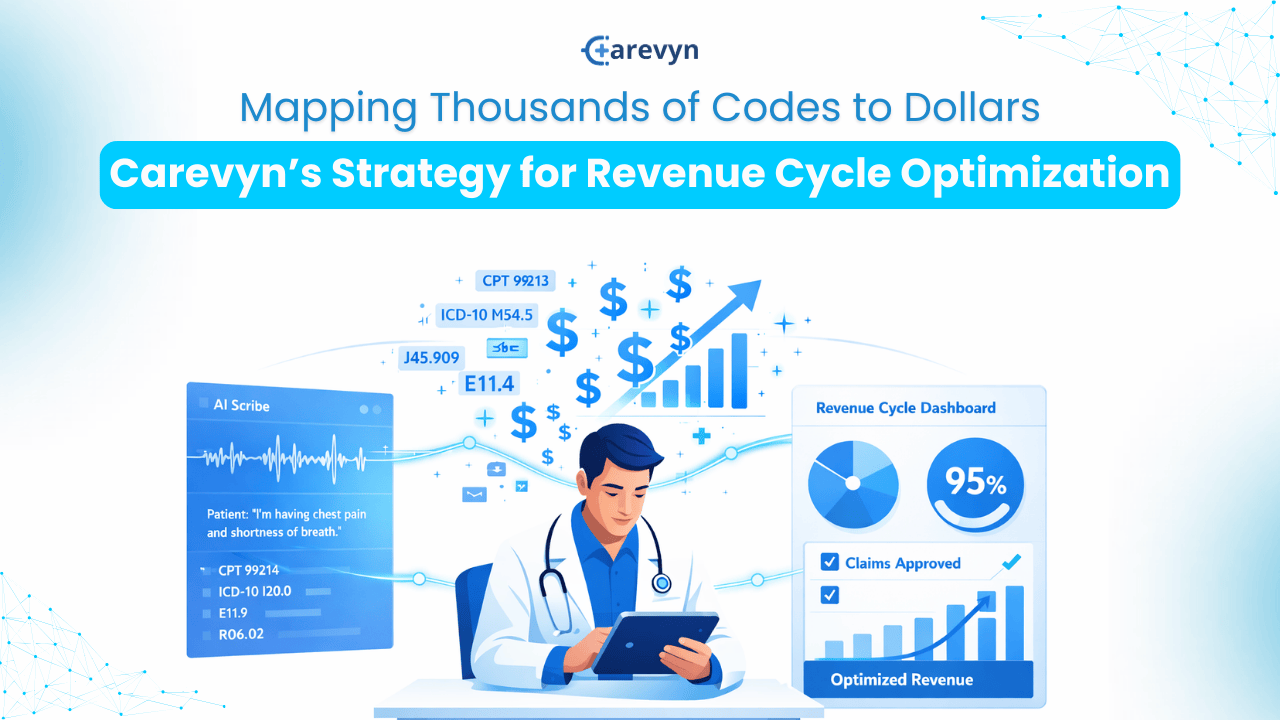
Understanding Revenue Cycle Optimization
Revenue cycle optimization refers to analyzing ways that a healthcare provider can improve capturing, coding, billing and collecting payment for the services they provide.
Typically, the following elements are included in a revenue cycle:
1. Patient registration
2. Insurance verification
3. Clinical documentation
4. Medical codes (ICD-10, CPT)
5. Claim submissions
6. Denial management
7. Payment posting
8. Reporting and analytics
Any weak point throughout the above process is a potential impact to revenue.
Carevyn’s strategy focuses on optimizing the revenue cycle through:
1. Increased clean claims
2. Decreased claims denials
3. Improved coding accuracy
4. Prevention of revenue leakage
5. Faster reimbursement timelines
6. Greater financial transparency
The Core Problem: Thousands of Codes, Millions at Risk
While a clinic with 200 beds may have tens of thousands of different diagnosis and procedure codes each month; each ICD-10 code represents a diagnosis which will impact payment and each CPT code represents a billable service.
Revenue is lost or compliance is jeopardized when:
1. Code is incomplete
2. Code is inaccurate
3. Code is undocumented
4. Code is under-coded
5. Code is over-coded
The traditional way of managing medical billing revenue cycles utilizes audits done manually, are reactive rather than proactive and require a lot of time.
The Carevyn way of doing medical billing revenue cycle management is to apply a proactive, totally-system type of approach that connects codes to revenue.

What Carevyn Has Learned from Revenue Data
Through large-scale revenue cycle analysis, one clear pattern emerges:
Revenue loss rarely comes from one major mistake. It comes from thousands of small gaps.
1. Small Amounts Can Add Up to Substantial Revenue Loss
Through large scale evaluations of revenue cycles Carevyn has concluded that there is a consistent trend — that revenue loss does not occur solely from one major error but builds up due to the numerous, seemingly small, unnoticed gaps along the billing and documentation workflow.
2. Common Patterns of Revenue Leakage
Recurring issues are a large part of the leakage:
• Missing secondary diagnoses from ICD-10 medical billing
• Incomplete or insufficient clinical documentation
• Charge capture gaps
• Misuse of modifiers
• Delay in claims resubmitting
• Poorly defined denial tracking processes
Individually they may appear to be minor issues however collectively they create a significant financial impact.
3. The Three Pillars of Revenue Optimization
Carevyn's investigation showed that sustainable revenue optimization is dependent on 3 core pillars being aligned:
-
Codifying Accurately- Accurately and completely coding the ICD-10 and CPT.
-
Quality of Documentation - Strengthening clinical documentation to help support claims defensibility.
-
Financial Analytics - Using data to identify trends, denials and performance gaps.
Without these 3 areas being aligned, even the best performing billing teams cannot optimize their reimbursement rates or maintain their revenue integrity.
Revenue Optimisation through ICD-10 Medical billing
ICD-10 medical billing establishes the basis of revenue receipt, where the diagnosis codes impact risk adjustment scoring, the severity of illness classification, case mix index, DRG assignment and ultimately reimbursements from payers. When ICD-10 codes do not correctly reflect the true clinical condition of the patient, then the reimbursements will decline (and/or significantly).
A common problem found in ICD-10 billing is incomplete or insufficient documentation leading to unspecified codes, missed comorbidities, chronic conditions not being documented and lack of specificity of diagnoses. These gaps result in the clinical picture being less than accurate and thus will diminish financial results.
For instance, documenting "diabetes" is very different than documenting "type 2 diabetes with diabetic chronic kidney disease." The latter provides specificity clinically and therefore materially impacts reimbursement with regard to risk adjustment and DRG.
Carevyn is also dealing with these issues by conducting structured audits of the ICD-10 coding trends, identifying under-coded diagnoses, mapping diagnosis patterns to financial variances and pointing out documentation gaps associated directly with lost revenue. This approach has changed coding from being a compliance-oriented job to being a proactive method of revenue optimisation.
.png)
Clinical Documentation Improvement (CDI): Turning Clinical Notes into Financial Accuracy
Clinical Documentation Improvement (CDI) ensures the accurate reflection of patient complexity within the providers' clinical notes. While CDI works to improve clarity and thoroughness of documentation, there is no change to the provider's delivery of care.
Vague documentation results in:
- Unable to assign precise ICD-10 codes by coders
- Downgrading of DRG assignment
- Reduction of reimbursement
- Increased audit risk
Carevyn integrates CDI into the revenue cycle optimization through:
- Recognition of documentation patterns associated with denials
- Identification of clinical notes with missing specificity
- Delivery of provider feedback loops of data
- Alignment of CDI with revenue analytics
Thus allowing documentation to support correct medical billing revenue cycle management.
"Revenue Leakage Prevention" - Finding the Silent Losses
Revenue leakage prevention is identifying reimbursements due but not received. Revenue leakage is typically due to small, non-obvious financial losses that occur over time through various operations and workflows in revenue management, coding, and finance.
Most common reasons for revenue leakage include: failure to capture charges, failure to adequately follow up on denied claims, under-coding, contracts that are not adequately analyzed, and unrecognized underpayments from payers. Over time, these losses are compounded resulting in substantial financial impact to the healthcare organization.
Carevyn uses revenue intelligence models to detect expected reimbursement vs. actual payment provide insights into the highest denial-performing CPT categories, and uncover underpayment trends by payer.
Mapping Codes to Dollars: Carevyn’s Strategic Framework
Carevyn’s revenue cycle optimization strategy follows a structured, analytics-driven framework.
Carevyn is using a structured, analytical approach to optimize the revenue cycle through code mappings and measuring their connection to financial outcome. The objective is to move from a reactive approach to billing management to one that is proactive, using revenue intelligence, as its basis.
Step 1: Code-Level Revenue Mapping
The first step in Carevyn's revenue cycle optimization strategy is to conduct a code-level revenue mapping process. Each ICD-10 and CPT code are analyzed in order to determine how they compare to historical reimbursement data, denial rates, DRG impacts and payer specific variance. This granular coding mapping allows for the identification of codes that consistently generate stable revenue, and those which represent a financial risk or variability.
Step 2: Financial Variance Analysis
Expected reimbursement will be compared to actual reimbursement on a systematic basis so that, in the event of a variance, Carevyn can identify the reason for the variance; e.g., incomplete documentation, coding errors, claim denials and/or underpayment by the payer. By eliminating any guesswork, this process gives Carevyn measurable insight into its billing process.
Step 3: Documentation Risk Identification
Third, using the mapping and variance analysis data, Carevyn will identify documentation risk and link any coding variance back to the clinical documentation that has been identified as lacking. Carevyn will be able to look for documentation patterns, such as frequent usage of unspecified ICD-10 codes, missing secondary diagnoses, or under-documented conditions will be flagged. Structured, objective documentation improvement feedback will then be provided to the providers in order to assist with the integrity of documentation and correct reimbursement.
Step 4: Denial Intelligence
Finally, denial intelligence represents the fourth layer of the strategic framework. Carevyn utilizes data analysis to identify patterns in denials, including reasons for denial, behavior of payers, and high-risk combinations of CPT codes and ICD-10 diagnosis codes, in order to shift from reactive denial resolution to proactive prevention of denials.
Step 5: Continuous Revenue Optimization
Likewise, the continual optimization of revenue ensures a need for sustainability. Rather than treating revenue cycle improvement as a one-time audit process, Carevyn utilizes performance dashboards to continuously monitor clean claim ratios, number of days accounts are in receivable status, coding discrepancies, clinical documentation improvement, and revenue leakage trends — creating operational resilience and long-term financial stability.
Importance of Integrated Revenue Cycle Management
According to industry research, hospitals lose between three and five percent (3-5%) of the revenue generated from the healthcare services they provide to patients due to inefficient medical billing processes. While three to five percent may appear small, at $6-10 million annually for a $200 million organization, a three to five percent loss in revenue is substantial.
Shifting from traditional revenue cycle management (RCM) to optimized RCM requires:
-
Transparency of Data
-
Intelligent Coding
-
Alignment of Clinical Documentation
-
Automation
-
Predictive Analytics
Carevyn's approach to revenue cycle management integrates each of these elements into one cohesive model.
Compliance and Risk Assessment
In maximizing the revenue cycle, compliance with regulations is as important as revenue growth.
Audit exposure exists as a result of improper coding, either through over coding and/or under coding.
Carevyn's framework emphasizes:
-
The accuracy of ICD-10 codes for reimbursement.
-
Compliance with documentation requirements for reimbursement.
-
Transparent audit trails.
-
Quarterly internal reviews of documentation compliance compared to best practices.
Sustainable and defensible revenue growth.
Example in Action: The Ways Mapping Provides Outcomes
A cardiology division is seeing little to no revenue growth.
The following are findings from Carevyn’s evaluation of the department:
• There are numerous unspecified ICD-10 codes being utilized at a high rate.
• There is poor documentation of complications.
• There are high rates of denials related to certain CPT codes.
• There are trends of underpayment from two of the major payers.
After executing the outlined recommendations:
• CDI guidance improved the quality of documentation.
• The accuracy of coding improved.
• The rate of denials decreased.
• The underpaid amount was identified and collected on.
As a result, there was an increase in revenue without an increase in the number of patients.
This illustrates how mapping and tracking thousands of codes against corresponding dollar amounts can positively affect the organization’s financial position.
Revenue Cycle Optimization in the Future
The future of healthcare reimbursement will be becoming increasingly complex as a result of:
• Value-based care
• Risk adjusted reimbursement
• Varying contracts from payers
• Increased compliance requirements
These complexities will not be managed effectively.
Medical billing and revenue cycle management are becoming increasingly reliant on data and technology. With organizations utilizing AI-assisted coding analysis, they will be able to improve the accuracy of coding and identify undercoding or documentation gaps in real time. Predictive denial modelling will allow teams to predict which claims have the highest likelihood of being denied before they are submitted, so they can avoid unnecessary rework and delays in cash flow.
Revenue reporting is also moving to real time dashboards so that finance and operations leaders can immediately see how much they are getting reimbursed, how payers behave, and how coding varies. An integrated Clinical Documentation Improvement (CDI) feedback loop will integrate providers, coders, and revenue teams in a seamless manner to ensure that documentation supports clinical accuracy as well as financial results. Simultaneously, automated detection of revenue leakage will allow teams to identify missed charges, underpayments, and trends in denial early on rather than after they occur. Carevyn's vision supports this direction by establishing scalable, data-driven solutions that integrate coding, documenting, analytics, and financial intelligence into one cohesive revenue optimization process.
Final Note
Healthcare organizations generate a staggering amount of coded data on a daily basis. This coded data contains the narrative of financial success or failure.
When coding, documentation, and analytics are accurate, complete, and integrated, revenue will stabilize and grow. Conversely, when coding, documentation, and analytics are disassociated, revenue will escape silently. The main concentration of Carevyn's revenue cycle optimization strategy is clarity, structure, and measurable impact. By providing linkages between thousands of ICD-10 and procedure codes to financial outcomes, organizations can go from the realm of uncertainty and chaos in their revenue cycles to one of methodology and control.
To have success in an environment where margins are low and compliance plays an incredibly important role, improving the revenue cycle is not negotiable; it is essential from a strategy standpoint. Linking codes to dollars, while potentially an exercise in accounting, is a financial intelligence system that helps to ensure that all the services rendered are appropriately recognized, documented, and reimbursed.
That, in turn, is the foundation of sustainable healthcare finance.
Frequently asked questions (FAQs):
1. What is revenue cycle optimization and why is it important to healthcare organizations?
The revenue cycle optimization process consists of the way healthcare organizations improve the way that they capture, code, bill, and collect payment for services provided. Therefore, Revenue Cycle Optimization guarantees that the reimbursement received for the services rendered to patients will be accurate, minimizes the number of claim denials received, improves the cash flow of the organization, and mitigates revenue leakage. Small documentation or coding errors can lead to a large financial loss over time; without optimization, these errors continue to build.
2. How does the billing of ICD-10 affect reimbursement rates to healthcare organizations?
ICD-10 codes provide a means of defining the patient's diagnosis; therefore, ICD-10 codes play an important role when determining the appropriate DRG or risk-adjusted payment by a payer based upon the patient's diagnosis; subsequently, when the diagnosis is undercoded or is not sufficiently documented; the payment to the healthcare organization will be negatively affected.
3. What is the function of Clinical Documentation Improvement in regard to Revenue Cycle Management?
CDI (clinical document improvement), ensures that the provider’s documentation is complete and clearly represents the conditions of the patient and the services that will be provided. (CDI) will improve coding accuracy, reduce the potential for audit risk, and allow for higher levels of reimbursement by giving coders the ability to assign accurate diagnosis and procedure codes.
4. Definition of Revenue Leakage, as well as methods to prevent it.
Revenue leakage is the result of health care organizations being unable to receive full reimbursement for services performed. Undercoding, missing charges, denied claims, payer underpayment, and incomplete documentation create revenue leakage. To prevent revenue leakage, data driven analytics, coding audits, denial pattern analysis, and proactive monitoring systems must be used.
5. In what way does Carevyn improve Medical Billing Revenue Cycle Management?
By mapping thousands upon thousands of ICD-10/CPT codes with their corresponding financial outcomes, Carevyn provides a framework to support and strengthen Medical Billing Revenue Cycle Management (RCM). Intelligent analytics, documentation insight/accuracy, denial tracking along with revenue variance analysis identify hidden revenue gaps and provide structured plans/methods to improve accuracy, compliance, and overall financial performance.
Are You Prepared To Maximize Your Revenue Cycle?
If your company processes hundreds of thousands of codes/month and doesn't know how much money is leaking out, it's time to use data to optimize your revenue cycle.
Book an appointment with Carevyn to begin confidently mapping the codes you created into dollars.